How to Adapt a Transition Curriculum
for Different Student Needs
Every transition teacher knows the challenge: no two school years are ever the same.
Even with a strong transition curriculum, each group of students with disabilities brings different needs, abilities, and IEP goals. What worked perfectly last year may not meet the needs of this year’s students, especially if you have a new crew.
But that doesn’t mean you need to start over. The key is knowing how to adapt your transition curriculum so it stays meaningful, flexible, and student-centered. With a few tweaks, you can use the same scope and sequence while making sure every student, no matter their ability, gets what they need.
I’ve come up with some practical strategies to help you adjust your transition program year after year!

#1: Align the Curriculum with Student-Centered IEPs
The first place to look when adapting your curriculum is always the Individualized Education Program (IEP). It’s your blueprint for what each student needs to work on. If you match your curriculum goals to student-centered IEPs, you’ll avoid busywork and keep everything purposeful.
For example, let’s say your curriculum includes a career readiness unit. One student’s IEP goal might be to identify three personal job interests. For them, you can adapt the unit to focus on interest surveys, videos of different jobs, or job-matching games.
Another student’s IEP goal might be completing a simple job application. You can take the same unit but adapt it by role-playing as a hiring manager and filling out mock applications.
Instead of scrapping the unit, you’re bending it to fit each student’s transition goals. This keeps your lessons tied to IEP progress, which also makes documentation and IEP progress monitoring much easier.

#2: Differentiate the Same Lesson Across Ability Levels
Curriculum units often assume one level of readiness, but in SPED classrooms, students are rarely all at the same place. Instead of switching lessons entirely, use differentiation or offer leveled versions of the same activity.
For example, think about a lesson about fast food restaurant skills. Instead of giving every student the same reading passage and worksheet, you can create or find three differentiated levels:
- Level 1 (Errorless with reduced text): The passage is simplified into just a few short sentences with real-world pictures. Questions are errorless, such as pointing to the picture of fries when asked, “Which food is served at a fast food restaurant?” and tracing words.
- Level 2 (Reduced questions and choices): Students will read a shortened version of the passage with key vocabulary bolded. In the worksheet, there are a few multiple-choice questions and short-answer questions.
- Level 3 (Multiple choice and open-ended): Students get the full passage, then answer comprehension questions with three or more choices, along with open-ended prompts like “Why do people choose fast food restaurants?” or “What skills are needed to work at one?”

With this strategy, all students are engaging with the same topic, but the entry point is different for each learner.
You’re not making three separate lessons, just adjusting the difficulty and support so every student has a way to participate and learn better.
#3: Connect the Curriculum to Real-Life Practice
One of the easiest ways to adapt a transition curriculum for a new group of students is by choosing real-life applications that match your students’ needs and current abilities.
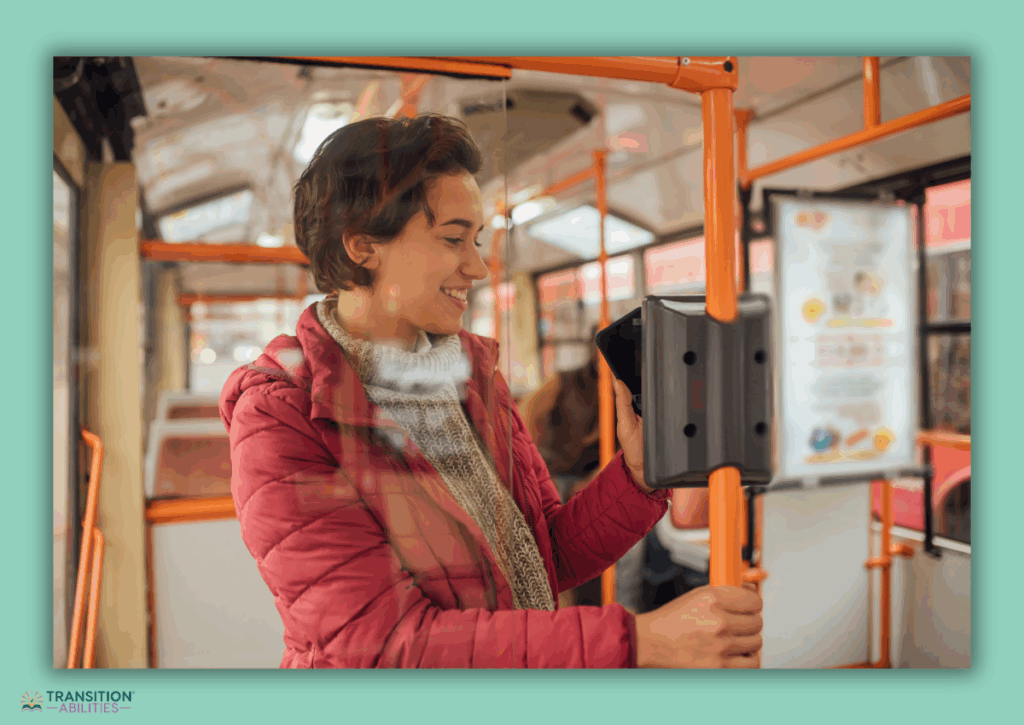
If the curriculum includes a public transportation lesson, one group might start with identifying road signs. Others may be ready to go out and practice riding a bus or the subway.
If your students are working on job skills, some may begin with in-class simulations like folding towels or stocking shelves, while others practice in a school-based business or community site.
Each year, your class will be at a different stage of independence. By tying lessons to real-life situations, you’re able to adapt the curriculum so that every student gets the same core instruction but at a level of practice that matches their abilities.
This keeps learning meaningful and prepares them for actual transition goals, not just classroom tasks.
#4: Break Big Curriculum Units Into Smaller Skills
Transition curriculum topics are often very broad, like “independent living” or “self-advocacy.” Those are important, but they can feel overwhelming if you don’t break them down. Scaffolding, or dividing a complex topic into simpler ones, makes it easier to adapt for a range of abilities.
Let’s take “self-advocacy” as an example:
- Lesson 1: What Is Self-Advocacy
- Lesson 2: Importance of Self-Advocacy
- Lesson 3: Building Self-Advocacy Skills
- Lesson 4: Advocating in Different Settings
You can also scaffold your activities:
- Activity 1: Identifying Self-Advocacy
- Activity 2: What Would You Do
- Activity 3: What Would You Say

By scaffolding the skill, you can adjust where each student enters. Some may stay at Activity 1 or 2 for a while, while others move ahead quickly. This makes your curriculum flexible without losing the bigger goal.
#5: Keep a Flexible Weekly Framework
A helpful way to balance structure with flexibility is to create a weekly framework for your transition curriculum.
This connects to your scope and sequence, but you still have room to shift the details based on your students’ needs.
Here’s one simple framework that works well in many classrooms:
Monday | Job Skills (Job application, mock interview, workplace habits) |
Tuesday | Independent Living Skills (cooking, cleaning, money math) |
Wednesday | Community (field trip, scavenger hunt, travel safety) |
Thursday | Social-Emotional Skills (self-advocacy, teamwork, small talk) |
Friday | Review & Reflection (journals, goal check-ins, group games) |
The advantage of this setup is that the scope and sequence stays consistent year after year. You’re always addressing the big domains, but the actual lessons inside each theme can change.
One year, “Independent Living Tuesday” might focus on laundry and clothing care; the next, it might shift to meal planning and grocery shopping.
This way, you don’t have to reinvent your curriculum every year. Instead, you adapt the lessons within your framework to fit the abilities and IEP goals of your current students.

Making Your Transition Curriculum Work for Every Student
Adapting a transition curriculum doesn’t mean starting from scratch. It’s about meeting students with disabilities where they are and stretching them toward their goals.
Each year will bring new challenges, but also new opportunities to celebrate neurodiversity and empower students through meaningful experiences.
When you build in differentiation, flexibility, and student-centered planning, your transition program becomes stronger and more reusable. That’s what makes teaching transition skills both challenging and incredibly rewarding!